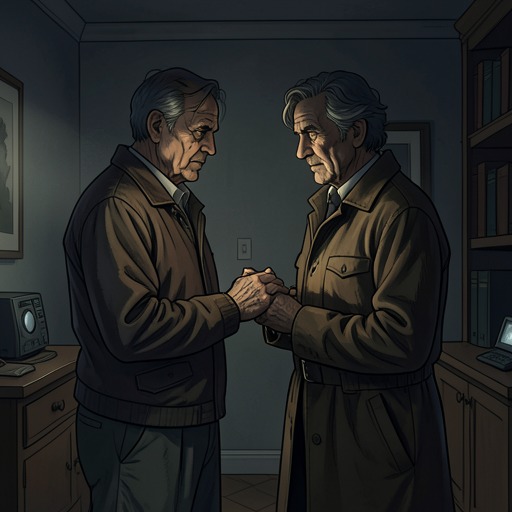
Emma Harte and Edwin Fairley
A Woman of SubstanceEmma Harte and Edwin Fairley’s relationship is the intimate beginning of a family conflict that outlives them both. Their youthful closeness becomes inseparable from the pain of their parting, but it does not remain only a private memory: decades later, the resemblance between Edwin and his descendant Jim Fairley brings the past into Emma’s family again. In allowing Paula to marry Jim, Emma finally refuses to make the young couple answer for an older generation’s history.
A youthful bond on the moors
Emma’s memory of Edwin is bound to the Yorkshire moors and to the place she calls the Top of the World. During a dream brought on by illness, she returns to herself at sixteen, running across the moors above Fairley village. Edwin is ahead of her, climbing towards the ledge beneath Ramsden Crags, where the two of them used to sit sheltered from the wind and look down at the world. She runs after him, breathless, and he helps her up onto the ledge. In the remembered scene, he assures her that they will live there forever.
The scene’s tenderness lies alongside its later sadness. Emma’s dream gives the young couple a shared place and an imagined permanence, but the adult woman knows that neither could hold. The dream breaks apart as she falls into a profound sleep, making the past appear not as a stable refuge but as something vivid that can return and then vanish. Edwin’s assurance of an endless life together becomes especially poignant beside the history Emma has actually endured.
Memory and the wound of separation
For much of Emma’s life, Edwin is difficult for her to summon clearly. When Paula admits that she stopped seeing Jim because she had become emotionally involved and feared the eventual heartache, Emma’s response reaches beyond the immediate conversation. The name Fairley brings Edwin sharply back to her: she sees him as if he were standing before her, with Jim, his spitting image, in his shadow. The old pain, which had seemed expunged, becomes present again with almost physical force.
Emma cannot readily answer Paula. Her sadness and physical exhaustion leave her unable to speak, and Paula, frightened by the expression on her grandmother’s face, tries to reassure her that the relationship is over and that she will go to Paris. After the haunted look passes, Emma regains control through the iron will that has sustained her. She begins to say that Jim is a good man, different from the others, and wants to tell Paula she may resume their friendship. Yet she stops herself: for Emma, the past remains immutable. Her silence shows how completely an old injury can govern a new decision, even when the person before her is not the one who caused it.
The wound is also larger than the two young people. Emma’s bitterness towards the Fairleys has shaped her protection of her family, and Paula knows that her grandmother would not accept a Fairley among them. Emma herself says that the Fairley family has touched her life with pain since she was fourteen. The relationship with Edwin therefore survives not as an ongoing romance but as a formative loss, converted into a lasting family boundary.
The past enters the next generation
Jim’s resemblance to Edwin makes Paula’s relationship an unusually direct return of Emma’s history. Emma has employed Jim at the Yorkshire Consolidated Newspaper Company and trusts him to run it, but professional confidence has not immediately dissolved her inherited prejudice. She had selected him because his ability impressed her and because he was the best candidate; she also admits that the thought of a Fairley working for her gave her satisfaction. She had not imagined that he and Paula would meet, since Paula had no connection with the publishing side of Harte Enterprises.
When Paula reveals how serious her feelings have become, Emma’s initial response is to see the old family name and the remembered young man behind Jim. Paula, meanwhile, tries to protect her grandmother by withdrawing from a relationship that might cause pain to either of them. Her concern makes the family feud active in the present: the old injury threatens to determine not only Emma’s view of Jim but Paula’s choices and future happiness. The resemblance that awakens Emma’s grief also exposes the unfairness of making a new couple bear the weight of a dead generation’s mistakes.
A changed inheritance
Emma eventually reverses her decision and gives Paula permission to marry Jim. She tells her granddaughter that Paula’s happiness matters more than her own pride and bitterness, and recognizes that obstructing Paula’s desire would be wrong. The reversal does not erase Emma’s memories of Edwin or pretend that the Fairley history was painless. Rather, it distinguishes Jim from the past that his name and likeness had brought back.
Emma understands her consent as a gift to Paula and Jim. She had tried to keep her children away from the Fairley family’s orbit, but had not thought to protect her grandchildren in the same way; by the time Paula meets Jim, he is the last Fairley. Emma’s decision thus changes what the family feud can transmit. Instead of passing the old prohibition on to Paula, she allows a relationship to be judged on its own terms and permits the Fairley name to bring joy as well as pain.
The book frames this resolution through Emma’s sense that life forms a circle: it began with the Fairleys and will end with them. That circle is not a claim that the generations repeat the same history unchanged. The likeness between Edwin and Jim makes repetition possible, while Emma’s blessing creates a break within it. Her relationship with Edwin remains the source of an enduring sorrow, but its final consequence is not another imposed separation. In permitting Paula and Jim to marry, Emma gives the next generation a chance to carry forward affection without inheriting her vendetta.